
Looking for the Best Kitchen Cabinets in Columbia, SC
Here’s What You Need to Know
Spend any real time in Columbia, SC and you quickly learn that the kitchen gets a serious workout. Between big family gatherings, humid summer afternoons that keep everyone indoors, and the kind of cooking culture that runs deep in South Carolina, this room pulls more weight than any other in the house. It needs to look good, hold up well, and actually function the way a busy household demands.
Most homeowners spend a lot of time thinking about countertop colors and cabinet door styles, which makes sense. But the decisions that really determine whether a kitchen remodel holds up over ten or fifteen years go a bit deeper than aesthetics. Material quality, cabinet construction, and how well your cabinets and countertops work together as a package, those are the things that separate a kitchen you will still love in a decade from one that starts showing wear far too soon.
Georgia Cabinet Co Kitchen and Bath works with homeowners across the Columbia Kitchen Cabinets projects. This guide is meant to give you a practical, honest look at what goes into choosing the right kitchen cabinets, which countertop materials are worth considering, and what the remodeling process actually involves from start to finish.
What Makes Kitchen Cabinets the Best?
Walk into any kitchen showroom and every cabinet on display looks good. The differences that actually matter do not show up until months or years into daily use, and by then you have already made your choice. So it is worth knowing upfront what separates a cabinet that holds its value from one that becomes a problem.
Construction is where it starts. Cabinets built with solid wood or quality plywood boxes, dovetail joints on the drawers, and full-extension slides are not just selling points. They are the difference between a cabinet that opens smoothly every single day and one that starts sticking or sagging. Soft-close hinges matter too, especially in a house with kids.
Materials have to suit the climate. Columbia gets humid. Really humid, for a good chunk of the year. Particleboard and low-grade MDF do not handle that kind of moisture well over time. They swell, they warp, and the finish starts peeling at the corners. Cabinets built for this region use moisture-resistant materials and finishes specifically because the environment demands it.
Storage design is often overlooked. A kitchen that looks great in photos but makes you dig through stacked pans every morning gets old fast. Good cabinetry is designed around how people actually cook, pull-out shelves, proper drawer depth, corner solutions that do not waste half the cabinet. That kind of functional thinking is what makes a kitchen genuinely pleasant to use day after day.
Types of Kitchen Cabinets in Columbia, SC
There is no single right answer when it comes to cabinet type. The best fit depends on your budget, your timeline, and the specific layout of your kitchen. Here is a straightforward breakdown of what each option actually involves.
Stock Cabinets
Stock cabinets come pre-built in fixed sizes and are typically available right away or with minimal lead time. The upside is speed and lower upfront cost. The downside is that your choices are limited. Standard dimensions may not align perfectly with your kitchen’s layout, and finishes tend to be fairly basic. They can work well for a secondary space or a smaller project, but they are rarely the best fit for a full kitchen renovation.
Semi-Custom Cabinets
Semi-custom cabinets give you meaningful flexibility without the full lead time of a completely custom build. You can adjust sizing to fit your space more precisely, choose from a wider range of door styles and finishes, and add interior features like pull-outs and dividers. For most Columbia homeowners doing a mid-range remodel, semi-custom hits a practical sweet spot between cost and customization.
Frameless Cabinets
Frameless cabinets skip the face frame that traditional cabinets use on the front of the box. The result is a cleaner, more modern look, and the full interior of the cabinet is accessible without the frame getting in the way. This style has picked up a lot of traction in contemporary South Carolina kitchen designs over the past several years.
Face-Frame Cabinets
Face-frame construction adds a solid wood frame to the front of each cabinet box, which gives the finished kitchen a more traditional, structured appearance. This style suits farmhouse, craftsman, and classic Southern home styles well. Given the mix of architectural styles across the Columbia area, face-frame cabinets remain a popular choice for homeowners who want a kitchen that fits the character of an older or traditionally styled home.
Best Kitchen Cabinet Styles and Trends in Columbia, SC
Design trends in Columbia kitchens tend to land somewhere between the timeless character of Southern residential architecture and the broader style movements that cycle through the home design world every few years. A few styles are standing out right now.
Shaker Cabinets
Shaker doors have been around long enough to prove they are not a passing trend. The recessed panel design is clean without being cold, and it adapts well to both traditional and modern kitchens. Across Columbia, shaker-style cabinetry shows up in renovated older homes just as often as it does in newer builds, which says something about how well the style translates across different settings.
White and Off-White Cabinetry
White kitchens remain dominant in the South, and there is a practical reason for that beyond aesthetics. In a warm-weather state, a brighter kitchen feels less closed-in during the long months when you are spending more time indoors. Off-white and cream tones in particular have been picking up ground lately as an alternative that feels a bit warmer and less stark than a pure bright white.
Two-Tone Cabinets
Pairing a lighter color on upper cabinets with a deeper shade on the lowers or the island has become one of the more popular moves in kitchen design right now. Charcoal, navy, and muted sage greens are showing up frequently on lower cabinets alongside white or cream uppers. It adds some visual dimension to the room without going overboard.
Natural Wood Finishes
After years of painted cabinetry dominating the market, natural wood is back in a real way. Lighter maple and white oak finishes are especially popular at the moment. They bring warmth into a kitchen that a painted cabinet just cannot replicate, and they pair well with the kind of stone countertops that are also trending right now.
Open Shelving Accents
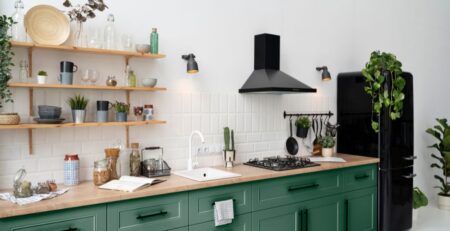
Replacing a section or two of upper cabinets with open shelving has become a practical design choice for homeowners who want to break up the visual weight of a fully enclosed kitchen. It creates a spot to display a few well-chosen pieces without committing to open shelving across the entire kitchen, which requires more discipline to keep looking good.
Cabinets and Countertops: The Perfect Match
Picking cabinets and countertops separately is a common mistake. Each one looks fine on its own at the showroom, but when they end up in the same kitchen, something feels off and it is hard to pin down exactly why. The reason is almost always that they were not evaluated together.
Color undertones are the usual culprit. A cabinet that reads as a warm white in the showroom can pull yellow or pink in your kitchen lighting, and if the countertop has cooler gray tones, the two fight each other in a way that is subtle but constant. Pulling samples from both categories and looking at them side by side, in your actual kitchen if possible, prevents that problem.
Texture and visual weight need to be balanced too. A heavily veined countertop against a busy raised-panel door style is a lot to look at. One of the two should take the lead, and the other should support it. Simple cabinets give a dramatic countertop room to breathe. More detailed cabinetry tends to work better with a quieter stone.
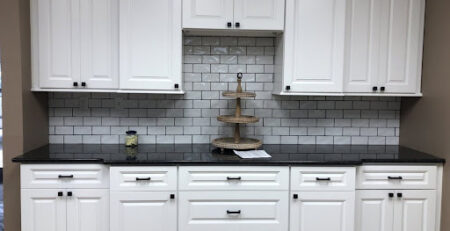
Hardware connects the two. A matte black pull on a white shaker cabinet ties directly to a countertop with dark veining. Brass or brushed gold hardware bridges warm-toned cabinets with a countertop that has golden or brown mineral movement. These connections do not happen by accident. They come from thinking about the full picture before anything gets ordered.
Granite Countertops in Columbia, SC
Granite has been a staple in kitchen remodeling for a long time, and it has held that position for real reasons. There is a lot of engineered surface material on the market now, but granite still does things that no manufactured product fully replicates.
The most obvious one is that every slab is different. The mineral formation that creates the pattern in granite happens over millions of years, and no two pieces come out the same. That means the countertop you select is genuinely one of a kind. For homeowners who want a kitchen that does not look like it came out of a catalog, that matters.
On the practical side, granite handles heat well. You can set a hot pan on granite without the surface damage that would occur with some other materials. It is also very hard, which means it resists scratching under normal kitchen use. Sealing is required periodically, and the edges can chip if something heavy hits them at a sharp angle, but those are manageable trade-offs for most households.
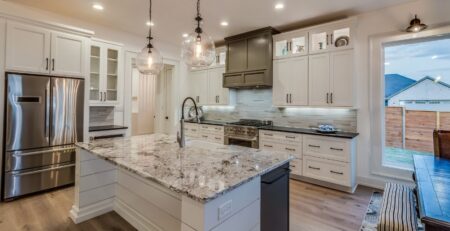
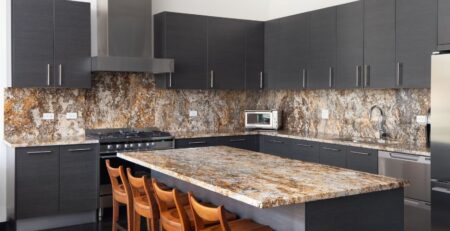
Some granite options that work well in Columbia kitchens: Uba Tuba is a deep, near-black stone with gold and silver mineral flecks that reads as sophisticated without being flashy. Bianco Romano has a softer, lighter gray pattern that suits more casual kitchen styles. Santa Cecilia brings warm golden-beige tones that pair naturally with cream or wood-tone cabinetry. Black Galaxy is a bolder choice for homeowners who want a strong visual contrast against lighter cabinets.
Granite rewards homeowners who are willing to give it a bit of maintenance attention. Keep it sealed, use cutting boards, and it will look sharp for a very long time.
Quartz Countertops in Columbia, SC
Quartz has earned its spot as one of the top countertop choices in the Columbia market, and the reasons come down mostly to practical day-to-day performance. It is an engineered material made primarily from natural quartz crystals, and the manufacturing process gives it properties that natural stone does not have.
The biggest one is that quartz is non-porous. Liquids do not absorb into the surface, which means spills that sit for a while do not stain the way they can with granite. Red wine, tomato-based sauces, coffee, none of those leave a mark if you wipe them up within a reasonable amount of time. For households that cook a lot or have young kids, that is a genuinely useful quality.
Quartz also does not need sealing. Granite requires a periodic resealing routine to maintain its stain resistance. With quartz, that step does not exist, which is one less thing to manage. The surface is also consistent across the entire slab, which makes it a clean choice for a large island or a long countertop run where uniformity matters.
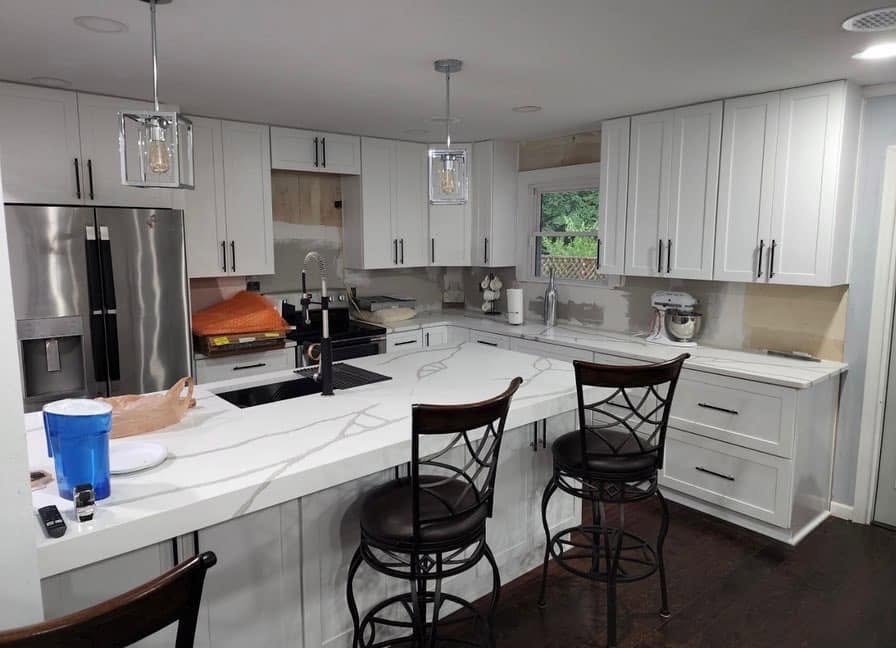
The design range for quartz has expanded a lot. Several manufacturers now produce quartz that is visually close to Calacatta or Statuario marble, with bold veining on a bright white background. Others offer softer, more muted tones in grays, beiges, and warm whites that complement a wide range of cabinet colors. There are also more textured and concrete-style finishes available for kitchens with an industrial or contemporary direction.
One practical note: quartz is not as tolerant of direct heat as granite. A hot pan placed directly on the surface can cause discoloration or surface damage. Trivets are a simple solution, and most quartz owners get into that habit quickly.
Kitchen Remodeling Process in Columbia, SC
A lot of homeowners underestimate how much is actually involved in a kitchen remodel until they are in the middle of one. Having a clear picture of what happens at each stage makes the whole thing less stressful and helps you make better decisions along the way.
Step 1: Consultation and Design
The first conversation is really just about listening. A good remodeling team asks about how you use your kitchen, what frustrates you about the current setup, what your style direction is, and what your timeline looks like. That input shapes a design and material plan that fits your actual needs rather than a generic template.
Step 2: Choosing Materials
Cabinet style, finish, and hardware get decided first, followed by countertop material and color. Seeing physical samples in person is important. Colors shift depending on the light in the room, and something that looked right on a screen or in a showroom can read differently once it is in your kitchen.
Step 3: Measuring and Ordering
Precise measurements are taken of the full kitchen to make sure cabinet runs fit correctly and countertop slabs are cut to the right dimensions. Once everything is confirmed, materials are ordered and a production and installation timeline is set.
Step 4: Demolition
Existing cabinets, countertops, and sometimes flooring come out during this phase. Any plumbing or electrical work that needs to happen before the new cabinets go in is typically completed here as well.
Step 5: Installation
Cabinets go in first. After that, countertop templating happens, which involves taking precise measurements of the installed cabinets so the stone slabs can be cut correctly. Once fabricated, countertops are installed, followed by hardware, backsplash, and any remaining trim work. A well-organized installation crew keeps this phase moving cleanly through to completion.
Why Choose Quality Cabinets Over Low-Grade Options
Budget pressure is real, and it makes sense to look for places to save during a remodel. Cabinets, though, are one area where cutting corners tends to backfire. The problems show up slowly enough that you might not notice them right away, but they accumulate.
Cabinets built with particleboard boxes and lightweight hardware start to show wear well before the rest of your kitchen does. In a humid climate like Columbia’s, particleboard absorbs moisture, and once that process starts, the swelling and warping follow. Drawer faces go crooked, doors stop aligning, and shelves start to bow under the weight of regular kitchen items. None of this happens overnight, but within a few years, it becomes a daily annoyance.
Solid wood and plywood construction handles moisture in a fundamentally different way. The joints hold, the surfaces stay flat, and the hardware continues to work the way it did on day one. There is a tactile quality to well-built cabinetry that you notice every time you open a drawer. It just feels different.
There is also the question of what happens when you sell. Buyers walk into a kitchen and form an impression quickly. Cabinetry that is starting to show its age works against you in that moment in a way that is hard to overcome with staging or cosmetic fixes.
Why Choose Georgia Cabinet Co Kitchen and Bath
Georgia Cabinet Co Kitchen and Bath serves homeowners across the Columbia, SC area with a focus on quality materials, skilled installation, and a remodeling process that does not leave customers guessing about what comes next. We work on kitchens of all sizes and styles, from focused updates to complete renovations.
Our cabinet selection covers a wide range of styles, finishes, and construction types, and we carry granite and quartz countertops that span a broad design range. The goal with every project is to help homeowners put together a kitchen that works well together as a complete package, not just a collection of individually selected pieces.
We also believe the process matters as much as the product. Keeping things organized, communicating clearly about timelines, and following through on what we say we will do, those things build the kind of working relationship that makes a remodel a good experience rather than a stressful one. Contact us to get a free quote and talk through what your kitchen project involves.
Conclusion
Getting a kitchen right in Columbia, SC takes more than picking a cabinet color and a countertop that looks good together. The climate here puts real demands on materials. The lifestyle here means the kitchen gets used hard. And the investment involved means the decisions you make need to hold up over time, not just on installation day.
The good news is that quality options exist at every level of customization. There are cabinet types that suit straightforward layouts and ones that handle complicated older floor plans equally well. There are countertop materials that prioritize low maintenance and ones that prioritize a natural, one-of-a-kind look. Finding the right combination is the work, and having experienced people in your corner for that process makes a genuine difference.
Georgia Cabinet Co Kitchen and Bath is available to help with exactly that. Reach out to schedule a consultation and start building a kitchen that fits your home, your habits, and your long-term plans.
Frequently Asked Questions
Which cabinet material holds up best in South Carolina’s humidity?
A: Solid wood and plywood-based cabinets with a quality finish handle the local climate well. They resist the moisture and temperature swings that tend to cause cheaper materials to break down over time.
Is granite or quartz a better fit for a working kitchen?
A: Granite handles direct heat better and offers a natural, one-of-a-kind look. Quartz is non-porous and needs no sealing, which makes it easier to maintain. Which one fits better depends on how your household uses the kitchen.
Can new countertops be installed over existing cabinets?
A: Yes, if the cabinets are structurally sound and level. Your project team will assess the current setup before making a recommendation.
How long does the full remodeling process take?
A: It depends on the scope of the project. Your contractor will give you a specific timeline after the design and material selections are finalized.
How do I get the process started with Georgia Cabinet Co Kitchen and Bath?
A: Contact us to set up a free consultation. We will go over your goals, walk through material options, and put together a plan for your kitchen.